

We call people lucky if they exceed the average life expectancy. Afterall, longevity, or the ability to live a long life, is the goal for most individuals. However, healthy aging is about so much more than just reaching a certain birthday. It is about maintaining the ability to do what you need to do, want to do, and like to do as late in life as possible. This is known as functional longevity.
Both my mother-in-law and father-in-law achieved longevity, living to the ages of 96 and 90, respectively. However, there was a huge difference in their quality of life in late adulthood.
My father-in-law was a physically strong and energetic man with a handshake so strong that it was painful to be on the receiving end of it. He had tremendous endurance and could walk miles without tiring. He led a physically active life right up until his death, and prided himself on his vegetarian diet. He had been an electrical engineer in his working life, and he continued to read and do mentally challenging activities after he retired. The stroke that finally debilitated him and led to his rapid demise was due to a genetic heart valve problem that he stubbornly refused to treat with blood-clotting medication. Had he taken the medication, he most likely would have lived several years longer.
In stark contrast, my mother-in-law fared much worse through her late adulthood. After graduating high school, she had never done anything to intellectually stimulate her mind. She didn’t have a computer or even a cell phone. She was physically inactive most of her adult life. By the time she reached her 80s, her muscles had atrophied to the point that she began to lose the ability to walk on her own. She became wheelchair-bound, then eventually completely bedridden. She developed dementia and began losing her memories of people and events. Eventually, she lost control of her bodily functions and needed to be placed in a nursing home for round-the-clock care the last five years of her life.
What my mother-in-law lacked but my father-in-law had in spades was functional longevity. He was able to do all the things he needed, wanted, and liked to do right up until his fatal stroke. He truly had an excellent quality of life all throughout his life.
When you understand and adopt the concept of functional longevity, it is possible to be healthy, robust, energetic, vibrant, and functional well into your golden years.
Redefining Vital Signs of HealthyAging
Traditional vital signs of health status, such as pulse, respiration, blood pressure, and blood oxygenation level, are considered crucial in medical emergencies. However, in everyday life, when no emergency is present, the normalcy of those numbers is expected, with the possible exception of blood pressure, which can deviate from normality even in a nonemergency situation.
It is important to realize, though, that having normal vital sign numbers doesn’t so much grant you a clean bill of health as indicate that you are not in acute danger. But when it comes to your health span, there are other more important signs indicative of health and wellness that can be assessed by the following:
• blood (biomarker) tests
• functional fitness tests
• preventive wellness exams that screen for chronic diseases, such as cancer and heart disease
• adherence to lifestyle behaviors
• body weight/body composition measures
To be sure, the goal of achieving a healthy lifestyle and healthy aging has always involved a multi-pronged approach, utilizing many lifestyle variables, the most well-known being eating a healthy diet, exercising regularly, getting intellectual stimulation, managing stress, maintaining a healthy weight, and undergoing preventive exams.
Now, however, cutting-edge research indicates that if we are seeking to achieve the goal of functional longevity, we must focus much more heavily on the exercise aspect of our lifestyle, as the research is now showing that there are six tests of physical ability that are highly predictive of functional longevity, or health span, in addition to body composition. However, according to a physician-researcher at the Mayo Clinic who is one of the world’s leading experts on human performance and exercise physiology, almost any bodyweight exercise or test of strength, coordination, and fitness is highly predictive of life span.
The main message is that frailty, inactivity, and low fitness do not bode well for people in the long term.
7 Predictors of a
Long Health Span
So, how can you measure functional longevity? Researchers continue to discover lifestyle factors that act as predictors, or “vital signs,” of healthy aging and longevity. Consider these seven indicators of aging well:
1. Body Composition
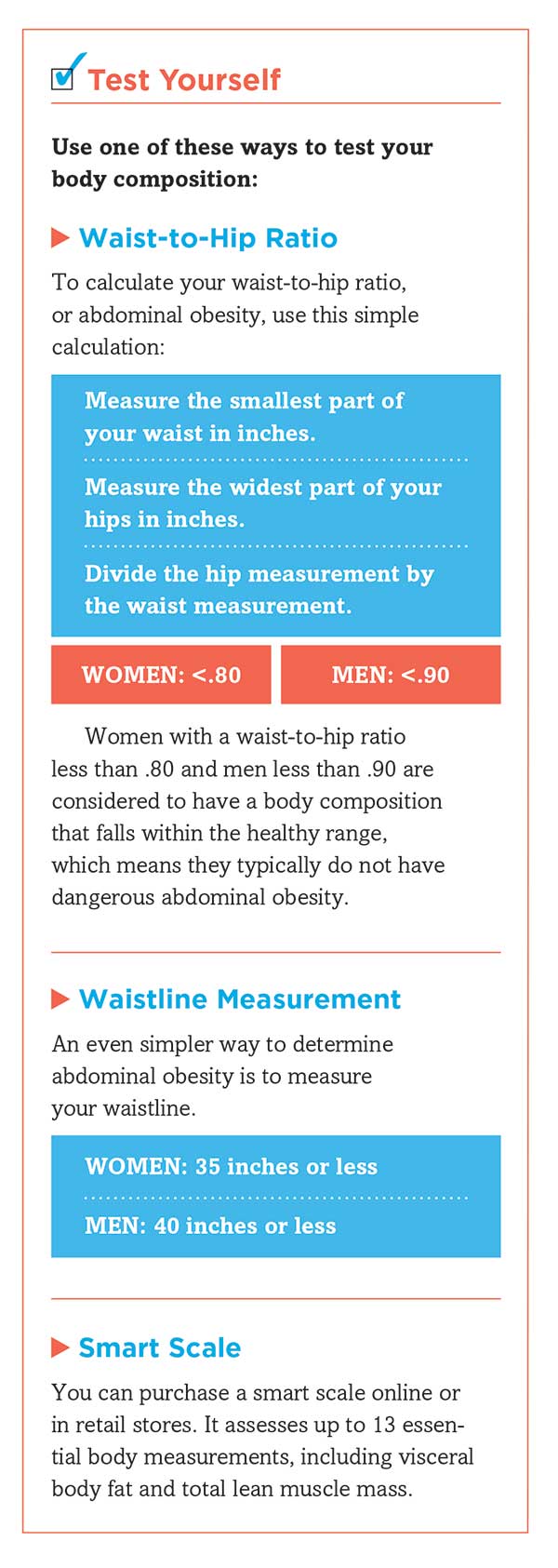
Body composition refers to all the essential elements that comprise an individual’s total body weight, such as fat, muscle, water, bone mass, and protein. Physicians are typically concerned with the issue of a patient’s total body weight in relation to height, as determined by body mass index (BMI). It is commonly used by most physicians today to calculate risk factors for the most prevalent chronic diseases, including heart disease, cancer, and type 2 diabetes. However, the BMI has two inherent flaws: It does not take body composition (ratio of fat to lean muscle) into account, and it does not assess abdominal obesity (dangerous visceral belly fat), which is a known risk factor for heart disease, stroke, and type 2 diabetes.
Since health is more strongly correlated with body fat percentage and distribution, a better approach to assessing current health problems and predicting future ones is evaluating body composition through a multipronged approach.
2. HandGrip Test
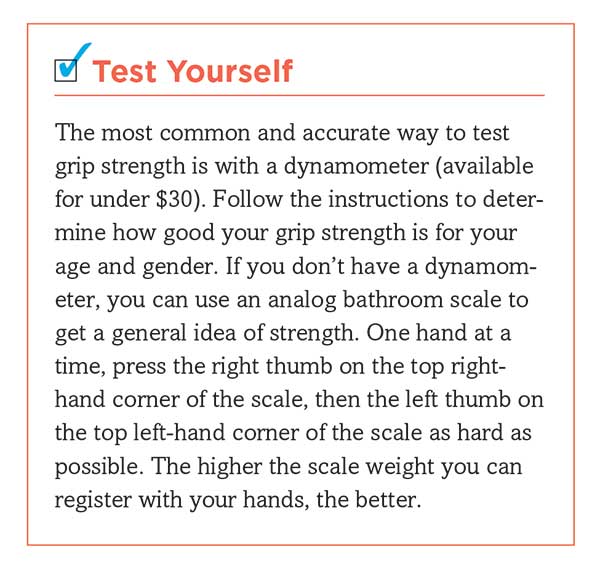
A study found that the firmness of one’s handgrip is highly correlated with cardiovascular disease, chronic lung disease, and many cancers. It can be an indicator of your risk of early death, disability, and illness. In fact, grip strength is a better predictor of mortality than blood pressure or overall physical activity. Research has found that grip strength among people in their 80s helps predict their likelihood of living beyond age 100.
Grip strength can be lost naturally as you age, especially after age 65, which can make it harder to do everyday tasks, such as opening jars or holding a steering wheel.
Studies have shown that handgrip strength is also strongly associated with lower limb strength, which is highly correlated with longevity, as strong leg muscles mean better mobility and reduced falls.
To strengthen your grip, routinely do these simple exercises:
Squeeze a tennis ball or stress ball as hard as you can for three to five seconds, then rest briefly. Repeat 10 times with each hand.
Wring water out of a washcloth.
Play with clay.
3. Walking Speed (Gait)
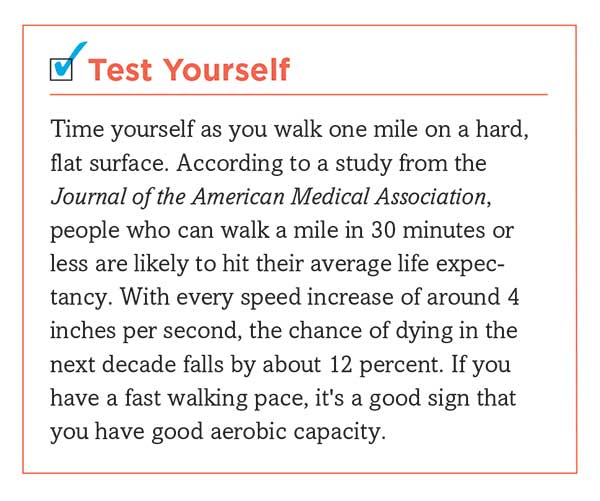
A study of over 35,000 adults, age 65 and older, found that those with greater walking speeds lived longer than those with a slow gait. A good walking speed is about 2.6 feet per second, which means walking about a mile in half an hour.
“Walking speed is recognized, yet underutilized, as a measure and predictor of a person’s health. It can be used as a vital sign much like blood pressure, temperature, heart and breathing rate, and pain,” according to Janet Prvu Bettger, associate professor and director of health policy and implementation science at Duke University’s Department of Orthopedic Surgery.
4. Chair Test
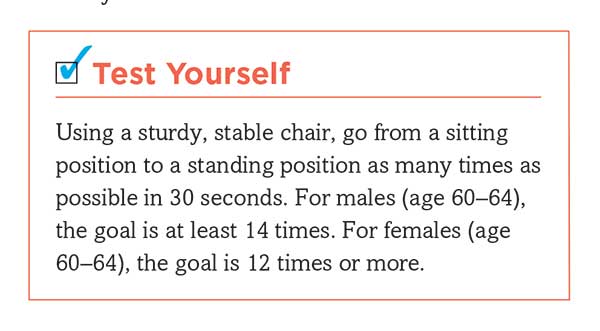
The chair test measures how many times in one minute you can sit on a chair, stand up, and then repeat. To do this repeatedly, a person must have quadricep (muscle thigh) strength, balance, and some endurance, all of which are the opposite of frailty.
5. Standing Stork Test
The standing stork test measures your ability to balance on one foot for one minute. This ability is linked to longevity because it is strongly related to coordination, and it helps prevent injury.
6. Ability to Do Push-Ups
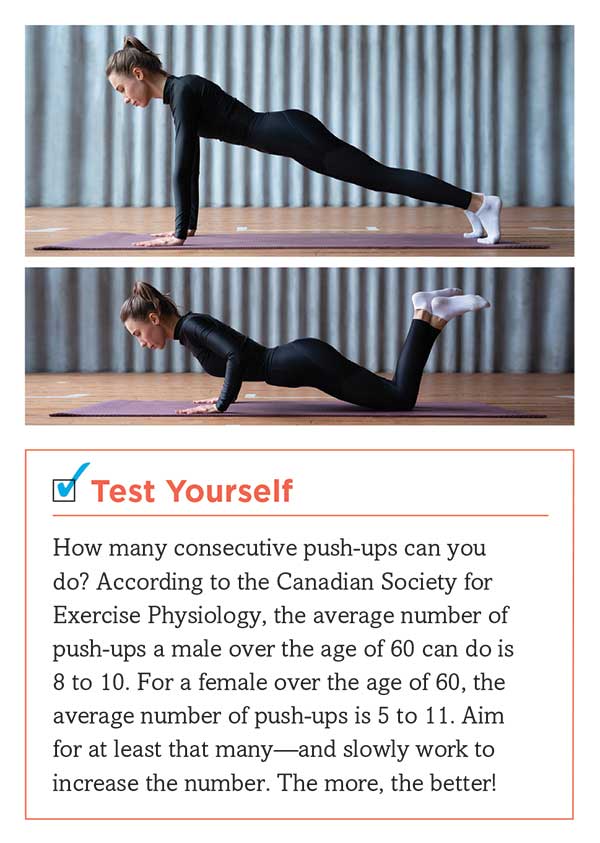
Research has demonstrated that push-ups have been linked to reduced heart disease in certain populations. A study of more than 1,500 firefighters (up to the age of 66) showed that the more push-ups a person could do, the lower their risk of heart disease.
Depending on fitness level, one can do either the more difficult standard type, using an on-the-toes position, or the easier modified version, using an on-the-knee position.
7. Treadmill Test
A treadmill test measures your cardiovascular health by determining what percentage of your mass heart rate you reach before stopping.
Since heart disease is the leading killer of people today, having good cardiovascular health is essential for achieving functional longevity.
How Old Are You?
How Old Do You Feel?
Over the past 100 years, the average life expectancy has dramatically increased, currently to 78 years for a man and 82.65 years for a woman. With modern advances in medicine, ultimate life expectancy is achievable for many. But reaching a very old age without the physical and mental abilities to have the quality of life one wants would not be desirable for anyone. The goal, then, is to achieve functional longevity. It is within most people’s grasp, if they make the right lifestyle choices early in life.
Accept your chronological age without letting that age limit who you are and who you want to be.
Terry Leitma is a college instructor and health educator. She lives in Delmar, Maryland, with her husband.